It is estimated that 20 million Americans live with peripheral neuropathy, a condition that affects the nerves outside the brain and spinal cord. These nerves transmit signals between the central nervous system and the rest of the body, especially the arms and legs.
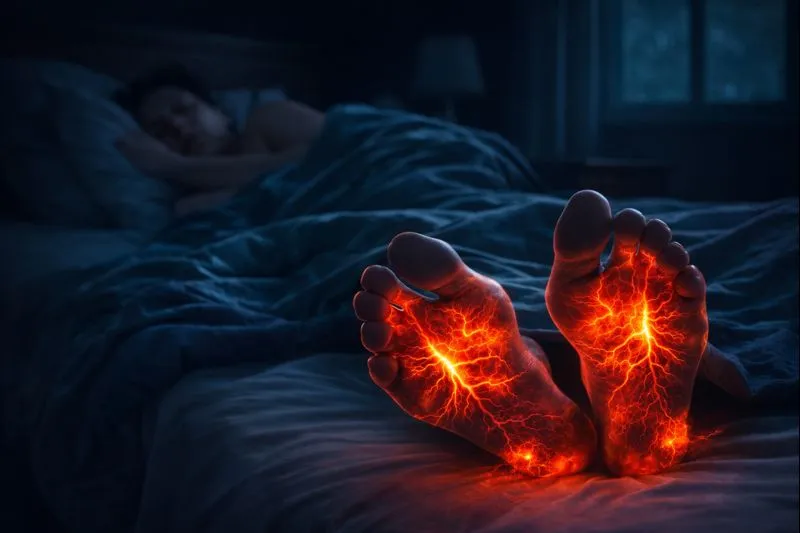
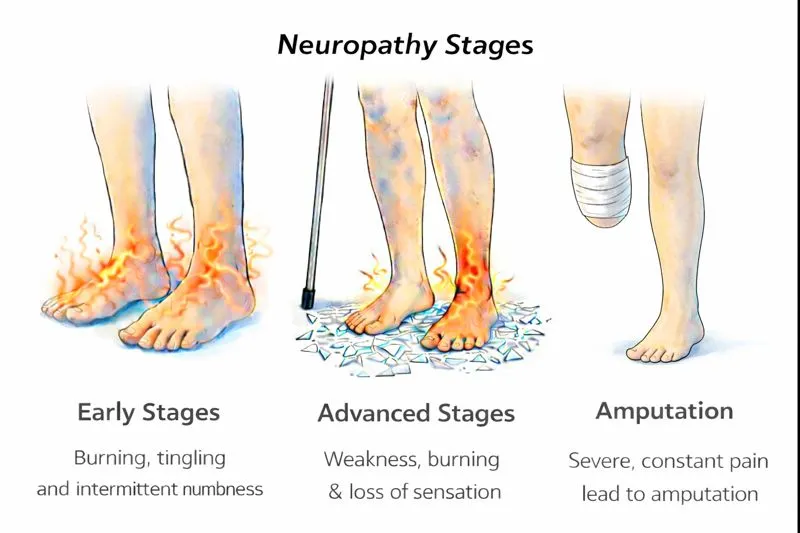
For most people, neuropathy begins in the same way: burning in the feet at night, tingling in the toes, and intermittent numbness.
Then the situation worsens.
The feet weaken.
The legs burn or lose sensation.
Balance becomes unstable.
Sleep turns into a nightly battle.
Many describe the sensation as walking on shards of glass, stepping on hot embers, or feeling sudden electric shocks running through the feet and legs.
In more advanced stages — when the pain becomes constant and no longer responds well to usual approaches — some patients begin to consider “amputation” as the only way to escape the suffering.
In the United States alone, more than 300,000 people are amputated every year due to complications associated with neuropathy.
For a long time, this was the only path presented: trying to control the pain as it worsens — or accepting increasingly extreme measures.
The problem is that, for many patients, none of this seemed to stop the progression of neuropathy. Even with medications, procedures, and radical decisions, the symptoms continued to advance.
It was this frustration — temporary relief without ever truly resolving the problem — that led researchers to question whether the condition was being treated in the right way.
From that point on, new research began to look beyond traditional explanations.
One such study, conducted by scientists at Harvard, found that nerve damage may be linked to the accumulation of a corrosive toxic substance that binds to nerve tissue and compromises the myelin sheath — the protective layer that allows nerve cells to communicate properly.
These findings helped explain something that Dr. Michael Stevens, a neuroscientist with more than 20 years of experience, had already been witnessing firsthand.
Over the years, he followed patients who adhered to every medical recommendation and still continued to worsen. For many, the available treatments only attempted to contain the pain, without preventing the condition from progressing.
This reality became even more personal when his own father began living with neuropathy, dealing daily with pain, limitations, and the lack of real alternatives beyond traditional approaches.

neuroscientist
neuroscientist
For Dr. Stevens, those outcomes could not be accepted as definitive.
It was during a routine laboratory experiment that something unexpected happened. An accident caused extracts from an extremely resilient desert plant to come into contact with damaged nerve cells. Instead of worsening the condition, the plant’s compounds appeared to interfere with the process that kept the damage active, immediately capturing the team’s attention.
Based on this observation, Dr. Stevens developed a completely natural and non-invasive approach, aimed at people who had already tried everything without success.
Today, more than 14,000 people have already used this method, including many cases considered advanced or unresponsive to conventional approaches.
One of those people was Sarah. After years living with constant pain, burning, and tingling — and without concrete answers — she believed that amputation might be her only way out. However, after beginning treatment with Dr. Stevens, her pain, burning, and tingling disappeared, marking a true turning point in her life.
And that is exactly what Sarah and Dr. Stevens explain in the video below.
In this video, you will see:
- Why neuropathy continues to progress even when the pain seems “controlled”
- What this toxic buildup may be doing to your nerves over time
- How a desert plant became fundamental to this discovery
- Why conventional approaches often fail to stop the underlying process
- How Dr. Michael Stevens’ natural approach helped thousands of people prevent the worsening of neuropathy